Rafflr vs PayBee: Why Pay $499+ When Rafflr Is $77?
PayBee is a well-known name in the charity gala and auction space. Their platform manages the entire gala experience -- live auctions, silent auctions, fund-a-need campaigns, and yes, raffles. But that comprehensive approach comes with a comprehensive price tag: $499 to $1,250 per event. If your primary need is a reverse raffle, that is 6 to 16 times what you would pay with rafflr. This comparison breaks down exactly what each platform offers and whether that price difference is justified.
rafflr includes all features at every price point. PayBee charges per event for gala packages.
Understanding the Two Platforms
PayBee positions itself as "the simplest way to run a virtual or hybrid fundraising event." It is a full-service gala management platform designed for organizations running large charity events with multiple revenue streams: live auctions, silent auctions, donation appeals, and raffles. The raffle component is one piece of a much larger toolkit.
rafflr is a specialist tool built for one thing: running in-person reverse raffle events. It provides the full-screen presenter display, animated number drawing, sponsor branding, and buy-back revenue tracking that make live reverse raffle events engaging and profitable.
The fundamental difference is scope. PayBee tries to be everything for a gala event. rafflr does one thing exceptionally well. Understanding this distinction is the key to making the right choice.
Feature Comparison
| Feature | rafflr | PayBee |
|---|---|---|
| Price | $77/event, $97/year, or $497 lifetime | $499 - $1,250/event |
| Primary Use Case | In-person reverse raffle events | Galas, auctions, and fundraising events |
| Reverse Raffle Mode | ✓ Purpose-built | ✗ Not supported |
| Full-Screen Presenter View | ✓ With animations | ✗ No raffle presenter |
| Auto-Pull Drawing | ✓ All plans | ✗ |
| Sponsor Branding on Board | ✓ All plans | ✗ No raffle board |
| Buy-Back Revenue Feature | ✓ All plans | ✗ |
| Live Auction Tools | ✗ | ✓ |
| Silent Auction | ✗ | ✓ |
| Fund-a-Need / Donation Appeals | ✗ | ✓ |
| Online Ticket Sales | ✗ | ✓ |
| Payment Processing | ✗ | ✓ |
| Setup Time | 60 seconds | Hours to days (event configuration required) |
| Refund Policy | ✓ 30 days | ✗ |
| Transaction Fees | None | Payment processing fees apply |
Where PayBee Excels
Being honest about PayBee's strengths makes this comparison useful rather than just promotional. PayBee is a powerful platform for the right use case.
Full Gala Event Management
PayBee excels as a complete gala management tool. If you are running a large charity gala with a live auctioneer, silent auction tables (physical or digital), a fund-a-need appeal, and a raffle, PayBee provides a single platform that handles all of it. The auctioneer can manage bids in real time, guests can bid from their phones, and donations are tracked across all revenue streams. For complex multi-component events, this integration has real value.
Virtual and Hybrid Events
PayBee built strong virtual event capabilities, particularly during the era when in-person events were limited. Their platform supports remote bidding, livestream integration, and virtual attendee participation. If you need guests to participate from home and in person simultaneously, PayBee's hybrid tools are well-developed.
Payment Processing and Reporting
PayBee handles all payment collection, receipt generation, and financial reporting for your event. At the end of the night, you get comprehensive reports showing revenue by category -- auctions, donations, raffle tickets, and fund-a-need. For organizations that need consolidated financial reporting across multiple revenue streams, this is genuinely useful.
Dedicated Support
At $499 to $1,250 per event, PayBee includes hands-on support. Higher-tier packages include a dedicated event manager who helps with setup and is available during your event. For organizations that are not tech-savvy and need someone to walk them through every step, this human support can be worth paying for.
See rafflr in Action
Watch a 2-minute demo of how easy it is to run a reverse raffle with professional software
Where rafflr Excels
rafflr's advantages are concentrated in the live reverse raffle experience and the value-for-money proposition.
The Reverse Raffle Format
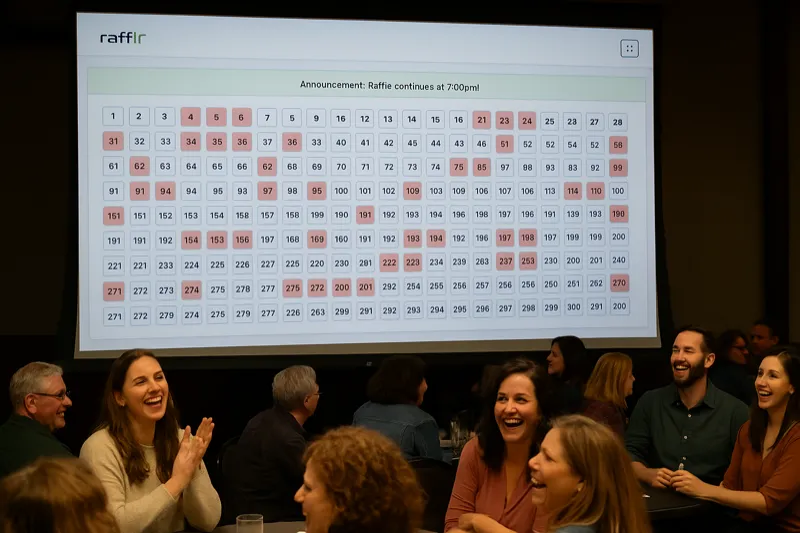
PayBee supports standard raffles where a random winner is drawn from a pool of entries. It does not support the reverse raffle format where numbers are eliminated one by one until a final winner remains. This is a fundamentally different event experience that creates sustained tension and engagement throughout the evening. rafflr is built from the ground up for this format, with features like number-by-number elimination, animated drawing, and the dramatic reveal of the last ticket standing.
Full-Screen Presenter Mode
rafflr's presenter mode displays a full-screen ticket grid designed for projectors and large screens. As numbers are drawn, they animate off the board. The audience watches in real time as their numbers survive or get eliminated. This visual experience is what turns a raffle from a quick announcement into an evening-long entertainment centerpiece. PayBee has no equivalent raffle presentation display.
Sponsor Branding
Display sponsor logos and messages directly on the raffle board that is projected for the entire room to see all evening. This helps organizations sell and retain event sponsorships by offering tangible visibility. PayBee's raffle component does not include sponsor display on a raffle board because it does not have a dedicated raffle board.
Buy-Back Revenue
The buy-back mechanic is unique to reverse raffles and is one of the most powerful revenue drivers at these events. When a ticket holder is eliminated, they can pay a fee to re-enter the drawing. rafflr tracks buy-backs automatically. At many events, buy-back revenue alone exceeds the cost of the software by 10x or more. PayBee does not support buy-backs because it does not support the reverse raffle format.
Price: 6 to 16x Less Expensive
This is the most obvious difference. rafflr at $77 per event is a fraction of PayBee's $499 to $1,250 per event. For organizations running one or two raffle events per year, the savings are significant. And rafflr's $97 annual plan for unlimited events makes the gap even wider -- you could run 12 events per year for less than the cost of one PayBee event.
60-Second Setup
With rafflr, you enter your ticket count and start drawing. There is no event configuration, no auction setup, no payment gateway connection. The person running your raffle can set everything up in seconds with zero training. PayBee requires substantially more setup time because it is configuring an entire gala event, not just a raffle.
The Real Question: Do You Need a Gala Platform or a Raffle Platform?
The PayBee vs rafflr comparison ultimately comes down to one question: what kind of event are you running?
If your event is a full gala with live auctions, silent auctions, donation appeals, and a raffle component, PayBee provides an integrated solution that manages the entire event. The $499+ price tag covers a lot of functionality, and for large organizations raising $50,000+ at a single event, it can be a reasonable investment.
If your event is a raffle -- specifically an in-person reverse raffle dinner, party, or fundraiser -- PayBee is dramatically overpriced for what you need. You are paying for auction tools, donation management, and event infrastructure that you will never use. rafflr at $77 gives you a better raffle experience at a fraction of the cost.
Many organizations fall somewhere in between. They run a dinner event with a reverse raffle as the main attraction, plus maybe a small silent auction or 50/50 side pot. For these events, rafflr handles the raffle beautifully, and you can manage the silent auction with simple paper bid sheets or a free tool like BetterWorld. The combined cost is still far less than PayBee.
Cost Comparison for Typical Events
Here is what each platform costs for common event scenarios:
| Scenario | rafflr Cost | PayBee Cost | Savings with rafflr |
|---|---|---|---|
| 1 event per year | $77 | $499 - $1,250 | $422 - $1,173 |
| 2 events per year | $97 (annual plan) | $998 - $2,500 | $901 - $2,403 |
| 4 events per year | $97 (annual plan) | $1,996 - $5,000 | $1,899 - $4,903 |
| Lifetime (10+ years) | $497 (lifetime plan) | $4,990 - $12,500+ | $4,493 - $12,003+ |
The math speaks for itself. Over a 10-year period, an organization running one event per year saves a minimum of $4,493 by choosing rafflr's lifetime plan over PayBee. That is money that goes directly to your cause instead of to software fees.
What rafflr Does Not Do
Transparency matters. Here is what rafflr does not offer that PayBee does:
- No live auction management. If you need an auctioneer dashboard with real-time bidding, rafflr does not provide this.
- No silent auction tools. No mobile bidding, no bid tracking, no auction item catalog.
- No online ticket sales or payment processing. rafflr does not collect money. You sell tickets your way.
- No fund-a-need or donation appeals. These are gala-specific features that rafflr does not include.
- No dedicated event support staff. rafflr is self-service, designed to be so simple that support is rarely needed.
If any of these are critical to your event, PayBee may be worth the premium. But if your event is centered around a reverse raffle, you will get a better raffle experience from rafflr at a dramatically lower price. For a broader look at how raffle software pricing compares across all platforms, see our complete pricing guide.
Who Should Choose PayBee
PayBee is the right choice if:
- You are running a full-scale charity gala with live and silent auctions
- You need integrated payment processing and financial reporting across multiple revenue streams
- Your budget supports $499+ per event and you will use the full platform
- You need virtual or hybrid event capabilities with remote bidding
- Hands-on support from a dedicated event manager is important to your team
Who Should Choose rafflr
rafflr is the right choice if:
- Your event is an in-person reverse raffle dinner, party, or fundraiser
- You need a full-screen presenter display for a projector or large screen
- Sponsor branding and professional presentation matter to your organization
- Buy-back revenue is part of your event strategy
- You want to spend $77 instead of $499+ on raffle software
- Your volunteers need something that takes 60 seconds to set up with zero training
The Verdict
PayBee is a powerful gala management platform that handles auctions, donations, and raffles under one roof. If you are running a complex multi-component gala and your budget supports $499+ per event, it delivers real value.
rafflr is the better choice for organizations whose event is a raffle -- specifically an in-person reverse raffle. It provides a superior raffle experience with presenter mode, sponsor branding, and buy-back revenue at a price that is 6 to 16 times less than PayBee. The two platforms are not really competing. They serve fundamentally different event types at fundamentally different price points.
If you are reading this comparison, chances are your event is more raffle than gala. In that case, rafflr is the clear choice. Save the $400+ difference and put it toward your cause.
Experience the Difference
Every rafflr account includes a free demo raffle so you can see the presenter mode and animations for yourself. Sign up takes less than a minute, and all plans include a 30-day refund policy. Get started with rafflr today.
Frequently Asked Questions
Ready for Professional Reverse Raffle Software at a Fair Price?
All features. $77 per event. No gala-sized price tag.
Get Started with rafflr30-day refund policy on all plans