The best raffle app depends on your event type. For live reverse raffle events, rafflr ($77/event) offers the fastest setup and a professional full-screen presenter display. For free online raffles, Zeffy handles everything at no cost to nonprofits. For large-scale online fundraising campaigns, RallyUp provides the most features but charges a 5% platform fee. For multi-format nonprofit fundraising, BetterWorld combines raffles with auctions and crowdfunding. Here is how all eight platforms compare across pricing, features, and real-world performance.
Quick Comparison: All 8 Raffle Apps at a Glance
Before diving into individual reviews, here is a side-by-side look at every app covered in this guide. Use this table to narrow down your shortlist, then read the detailed breakdowns below.
| App | Best For | Rating | Cost | Online Tickets | Live Display |
|---|---|---|---|---|---|
| rafflr | Reverse raffles & live events | New* | $77/event, no fees | No | Yes (full-screen) |
| RallyUp | Online fundraising | 4.6/5 (G2) | Free + 5% fees | Yes | Limited |
| Zeffy | Budget nonprofits | 4.8/5 (Capterra) | Free (tip-based) | Yes | No |
| BetterWorld | Multi-format fundraising | 4.7/5 (G2) | Free + 5% fees | Yes | No |
| Chance2Win | Simple online raffles | N/A | Free tier available | Yes | No |
| RandomPicker | Random draws | N/A | Free tier available | No | No |
| Wheel of Names | Casual spins | N/A | Free | No | Spinner only |
| Rafflecopter | Shut down | N/A | N/A | N/A | N/A |
Ratings from G2 and Capterra as of March 2026. *rafflr is not yet listed on third-party review platforms.
Best Raffle App by Use Case
- Best for live events: rafflr -- full-screen display boards, auto-pull mode, flat pricing
- Best free option: Zeffy -- zero fees for registered nonprofits
- Best for online fundraising: RallyUp -- online ticket sales, auctions, and crowdfunding
- Best for nonprofits: BetterWorld -- multi-format fundraising with clean interface
- Best for casual draws: Wheel of Names -- free, no account required
- Best for certified draws: RandomPicker -- audit trail and compliance documentation
How to Choose the Right Raffle App
Not every raffle app does the same thing. Some focus on online ticket sales, others on live event presentation, and a few try to do both. Before you compare features, clarify what your event actually needs.
Define Your Event Type
The single biggest factor is whether your raffle happens online, in person, or both. An online-only fundraiser needs strong ticketing and payment processing. A live gala or reverse raffle needs presentation tools, display boards, and audience engagement features. Hybrid events need a platform that bridges both worlds.
Evaluate Pricing Models
Raffle app pricing falls into three buckets: flat-fee, percentage-based, and freemium. Flat-fee apps like rafflr charge a fixed amount regardless of how much you raise. Percentage-based apps like RallyUp take a cut of every dollar collected, which can add up fast on large campaigns. Freemium apps offer basic features for free but lock advanced tools behind paid tiers.
For a deeper dive into pricing across the broader software landscape, our best raffle software 2026 comparison breaks down costs for ten platforms.
Check Device Compatibility
The best raffle apps in 2026 are web-based, meaning they run in any browser on any device. This matters more than you might think. At a live event, you might set up on a laptop, control the drawing from a tablet, and check results on your phone. Apps that require a specific operating system or app store download limit your flexibility.
Look for Transparency and Support
Hidden fees, confusing pricing tiers, and slow customer support are common complaints across the raffle app space. Before committing, check whether the app publishes pricing openly, offers a money-back guarantee, and provides responsive support during your event window.
Consider Your Growth Path
If you run one raffle a year, per-event pricing makes sense. If you plan multiple events, an annual subscription saves money. Think about where your organization is headed, not just where it is today.
Detailed Reviews: 8 Best Raffle Apps for 2026
1. rafflr - Best for Reverse Raffles and Live Events
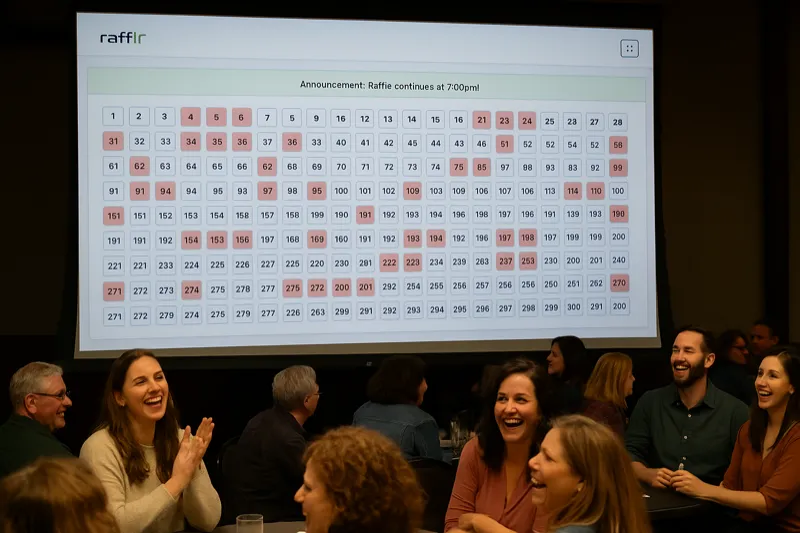
rafflr is a web-based raffle platform built specifically for live events, with a particular focus on reverse raffles. Unlike general-purpose fundraising platforms, rafflr is purpose-built for the in-person drawing experience: full-screen display boards, real-time number elimination, auto-pull mode, and sound effects that keep audiences engaged.
Setup takes under ten seconds. Enter the number of tickets, and your raffle board is ready. The presenter view works on any screen connected to a projector or TV, while you control the drawing from a separate device. Features like sponsor logo displays, exclude-number functionality, and CSV import/export round out the toolkit.
Pros:
- Purpose-built for reverse raffles with full-screen display boards
- Works on any device with a browser (no downloads)
- 60-second setup with intuitive interface
- Auto-pull and manual draw modes
- Sponsor recognition displays during events
- Flat pricing with no percentage fees
- 30-day refund policy
Cons:
- No online ticket sales (designed for in-person events where tickets are sold at the door or in advance offline)
- Not a general-purpose raffle or fundraising platform (built specifically for reverse raffles and live drawings)
- No free tier (every plan requires payment, though all include a free demo raffle to test before your event)
- Not yet listed on third-party review platforms like G2 or Capterra
Pricing: $77 per event, $97/year (unlimited raffles), or $497 lifetime. No platform fees on any plan.
Best for: Schools, churches, sports boosters, VFW posts, and nonprofits running live reverse raffle fundraisers. If your event involves a crowd watching numbers get drawn from a board, rafflr is built for exactly that scenario.
To see how rafflr compares head-to-head with other platforms, visit our feature and pricing comparison page.
What rafflr Cannot Do
In the interest of transparency: rafflr is not the right tool for every raffle. It does not sell tickets online, so if your fundraiser relies on remote ticket purchases, you need RallyUp, Zeffy, or BetterWorld instead. There is no free tier; the lowest entry point is $77 for a single event. And rafflr is not a general-purpose raffle platform. It does not run 50/50 raffles, basket raffles, or sweepstakes. It is built for one thing: live reverse raffle events with a crowd watching a board. If that is your event, it is the best tool available. If it is not, one of the other seven apps in this guide will serve you better.
See rafflr in Action
Watch a 2-minute demo of how easy it is to run a reverse raffle with rafflr
2. RallyUp - Best for Online Fundraising Campaigns
RallyUp is a full-featured online fundraising platform that includes raffle functionality alongside auctions, crowdfunding, and peer-to-peer campaigns. Its raffle module lets you create online ticket sales pages, set ticket quantities and pricing, and automatically draw winners when the campaign ends.
The platform shines for organizations running multi-format online campaigns. You can combine a raffle with an auction and a donation page under one umbrella. RallyUp handles payment processing, ticket distribution, and winner notification automatically.
Pros:
- Full online ticket sales with payment processing
- Combines raffles with auctions and crowdfunding
- Automated winner selection and notification
- Mobile-friendly ticket purchasing
- Customizable campaign pages
Cons:
- 5% platform fee on all transactions (plus payment processing fees)
- No live event presentation mode
- Can feel complex for simple raffle needs
- Platform fee adds up quickly on high-revenue campaigns
Pricing: Free to start. 5% platform fee on transactions plus Stripe processing fees (2.9% + $0.30). Premium plans with lower fees available.
Best for: Nonprofits running online-only raffle campaigns, especially when combined with other fundraising formats like auctions or crowdfunding.
3. Zeffy - Best Free Option for Nonprofits
Zeffy is the only raffle platform that charges absolutely zero fees to nonprofits. No platform fees, no payment processing fees, nothing. The platform sustains itself through optional tips from donors during checkout. This model makes Zeffy genuinely attractive for nonprofit organizations operating on razor-thin margins.
The raffle feature lets you create online ticket sales pages, set ticket prices, and draw winners automatically. Zeffy also includes event ticketing, donation forms, and membership management, making it a solid all-in-one for smaller nonprofits.
Pros:
- Truly free: zero platform fees for nonprofits
- Online ticket sales with built-in payment processing
- All-in-one: donations, events, memberships, and raffles
- Tax receipt generation
- Simple setup process
Cons:
- Donors see a tip prompt at checkout (can feel awkward)
- Only available to registered nonprofits (501(c)(3) or equivalent)
- No live event display or presentation features
- Limited customization options
- Basic reporting and analytics
Pricing: Free for nonprofits. Revenue comes from optional donor tips during checkout.
Best for: Small to mid-size nonprofits running online raffles who want to keep 100% of proceeds. Not suitable for live in-person events.
4. BetterWorld - Best for Multi-Format Fundraising
BetterWorld offers raffles as part of a broader fundraising toolkit that includes auctions, sweepstakes, crowdfunding, and event management. The platform positions itself as a one-stop shop for nonprofit fundraising, with a clean interface and integrated payment processing.
The raffle module supports online ticket sales, automatic winner draws, and customizable campaign pages. BetterWorld also provides marketing tools like email integration and social sharing to help promote your raffle.
Pros:
- Combines raffles with auctions, sweepstakes, and donations
- Clean, modern interface
- Built-in marketing and promotion tools
- Mobile-responsive ticket purchasing
- Free plan available for basic use
Cons:
- 5% platform fee on the free plan
- No live event drawing or display features
- Paid plans needed for advanced features
- Limited customization on free tier
Pricing: Free plan with 5% platform fee. Paid plans reduce or eliminate platform fees.
Best for: Organizations that want to run raffles alongside other fundraising formats like auctions and crowdfunding under one platform.
5. Chance2Win - Best for Simple Online Raffles
Chance2Win is a straightforward online raffle platform that focuses on making it easy to create, promote, and run online raffles. The platform handles ticket sales, random drawing, and winner notification with minimal setup.
What sets Chance2Win apart is its simplicity. There is no attempt to be an all-in-one fundraising platform. You create a raffle, set your ticket price and quantity, share the link, and the platform handles the rest. This focused approach makes it accessible for organizers who do not want to learn a complex system.
Pros:
- Simple, focused raffle creation
- Online ticket sales with payment processing
- Easy-to-share raffle links
- Automatic winner drawing
- Free tier for small raffles
Cons:
- Limited features beyond basic online raffles
- No live event tools
- Smaller user base means less community support
- Customization options are minimal
Pricing: Free tier for basic raffles. Paid plans unlock higher ticket limits and additional features.
Best for: Small organizations or individuals running simple online-only raffles without complex fundraising needs.
6. RandomPicker - Best for Certified Random Draws
RandomPicker is a random selection tool designed for contests, giveaways, and promotions. It is not a full raffle platform in the traditional sense. Instead, it focuses on providing a verifiably random winner selection process, complete with a certificate of authenticity for each draw.
You upload a list of entries (names, emails, or numbers), and RandomPicker handles the random selection with full audit trail documentation. This makes it popular for corporate giveaways, social media contests, and compliance-sensitive promotions. For a broader look at tools in this category, see our raffle drawing tools comparison.
Pros:
- Certified random draws with audit documentation
- Supports multiple draw formats (names, numbers, emails)
- Good for compliance-sensitive promotions
- Free tier available for small draws
- Video recording of draws available
Cons:
- No ticket sales or payment processing
- Not a full raffle management platform
- Interface feels dated
- No live event features
- Manual entry upload required
Pricing: Free for basic draws. Premium plans start at around $19 for additional features and larger entry lists.
Best for: Corporate giveaways, social media contests, and any situation where you need documented proof that the draw was random and fair.
7. Wheel of Names - Best Free Casual Tool
Wheel of Names is a free spinner wheel tool that lets you enter names or items and spin to select a random winner. It is not a raffle app in the traditional sense; there is no ticketing, no payment processing, and no event management. But it fills a niche for casual, low-stakes draws.
Teachers use it in classrooms, streamers use it for giveaways, and small groups use it for door prizes. The spinning wheel animation adds a visual element that audiences enjoy. You can customize colors, add images, and even embed the wheel on your own website. If you are evaluating simple pick-a-winner apps, Wheel of Names is worth a look alongside more feature-rich options.
Pros:
- Completely free
- Fun, visual spinning wheel animation
- No account required
- Customizable colors and entries
- Embeddable on websites
Cons:
- No ticket sales or payment processing
- No event management features
- Not suitable for large-scale fundraisers
- No audit trail or compliance features
- Limited to roughly 1,000 entries
Pricing: Free. Premium features available for a small monthly fee.
Best for: Classrooms, small group door prizes, casual giveaways, and any situation where a fun visual spin is more important than full raffle management.
8. Rafflecopter - Shut Down (No Longer Available)
Rafflecopter was once one of the most popular raffle and giveaway platforms on the internet, particularly for bloggers and social media marketers. The platform let you create embeddable giveaway widgets that encouraged entries through social actions like following on Twitter, sharing on Facebook, or subscribing to an email list.
As of 2024, Rafflecopter shut down its operations. The website is no longer active, and existing customers can no longer access their accounts or data. If you were a Rafflecopter user, you will need to migrate to an alternative platform.
Why it mattered: Rafflecopter pioneered the embeddable giveaway widget format and showed that raffle-style engagement could drive social media growth. Its shutdown highlights the risk of relying on any single platform without data portability.
Alternatives: For social media giveaways, consider Gleam or KingSumo. For actual fundraising raffles, the other seven apps in this guide are stronger choices.
Online Raffles vs. Live Event Raffles: Which Apps Fit?
One of the biggest mistakes people make when searching for a raffle app is assuming all raffle tools do the same thing. In reality, the raffle app market splits cleanly into two categories, and understanding this distinction will save you time and frustration.
Online Raffle Apps
Platforms like RallyUp, Zeffy, BetterWorld, and Chance2Win focus on the online experience. They handle ticket sales, payment processing, digital ticket delivery, and automated winner draws. These are ideal when your audience buys tickets remotely and the drawing happens automatically at a scheduled time.
Online raffle apps are strong for organizations with a dispersed supporter base. A national nonprofit, a school alumni network, or any group where supporters cannot physically attend an event benefits from online ticket sales. Keep in mind that online raffle laws vary by state, so verify compliance before launching.
Live Event Raffle Apps
Live event raffle apps like rafflr focus on the in-person experience. They provide presentation tools, display boards, real-time drawing, and audience engagement features. The drawing is the event, not just an afterthought.
If your raffle happens at a gala, banquet, sports event, or community night, you need an app that can project to a big screen and create excitement in the room. Full-screen display boards, pacing controls, and sound effects transform a simple number draw into entertainment.
Choosing Between the Two
Ask yourself: Will my audience be in the room or behind a screen? If they are in the room, prioritize live event features. If they are online, prioritize ticketing and payment processing. If you need both, you may need two tools working together, since no single platform currently excels at both.
Pricing Breakdown: What Raffle Apps Actually Cost
Raffle app pricing can be deceptive. A platform that advertises itself as "free" might take a significant percentage of your revenue. Here is an honest breakdown of what each pricing model costs in practice.
Flat-Fee Pricing
Apps like rafflr charge a fixed price per event or per year. You pay the same amount whether you raise $500 or $50,000. This model is predictable and rewards successful fundraisers. A $77 per-event fee on a $10,000 raffle is less than 1% of revenue.
Percentage-Based Pricing
Apps like RallyUp and BetterWorld charge a percentage of every transaction. At 5% plus payment processing (typically 2.9% + $0.30), the real cost on a $10,000 raffle is roughly $790 in fees. That is a meaningful chunk of revenue that could go to your cause instead.
Tip-Based (Zeffy)
Zeffy's model is genuinely zero-fee for the organization. Donors see a suggested tip at checkout (defaulting to 15%), and some feel pressured to contribute. Whether this is a "hidden cost" depends on your perspective, but it is worth understanding that your donors will see that prompt.
Real-World Cost Comparison
For a $10,000 online raffle:
- rafflr: $77-$97 (flat fee, but no online ticket sales)
- RallyUp: ~$790 (5% + processing)
- Zeffy: $0 to organization (donors may tip ~$1,500)
- BetterWorld: ~$790 (5% + processing on free plan)
What to Look for in a Raffle App in 2026
The raffle app landscape has matured significantly. Here are the criteria that matter most when evaluating your options this year.
Mobile-First Design
Whether your attendees are buying tickets or you are running the draw from a tablet, the app needs to work flawlessly on mobile. Test any app on your phone before committing. Clunky mobile experiences are a dealbreaker in 2026.
Data Security and Compliance
Raffle apps handle payment information and personal data. Look for SSL encryption, PCI compliance for payments, and clear privacy policies. If you are a nonprofit, verify that the platform meets your state's charitable gaming regulations.
Reliability Under Pressure
Your raffle app needs to work perfectly at the most critical moment: when everyone is watching the drawing. Test the app under realistic conditions before your event. Read reviews specifically about performance during live draws. A crash during the final moments of a reverse raffle is a nightmare scenario.
Data Portability
Rafflecopter's shutdown is a cautionary tale. Make sure any app you choose lets you export your data (participant lists, ticket information, transaction history). You should never be locked into a platform with no way to retrieve your information.
Integration with Your Workflow
Consider how the raffle app fits into your existing processes. Do you need to import participant lists from a spreadsheet? Export winner data to your CRM? Connect with your email marketing tool? The best app is the one that works with your systems, not against them.
Common Mistakes When Choosing a Raffle App
After reviewing hundreds of raffle events, these are the mistakes we see most often.
Choosing Based on Price Alone
A free app that crashes during your event costs more than a paid app that works perfectly. Factor in the cost of a failed event: lost donations, frustrated attendees, and damaged reputation. The cheapest option is rarely the most affordable in the long run.
Ignoring the Live Event Experience
Many organizations pick an online raffle platform and then try to use it at a live event. The result is usually disappointing: no display mode, no audience engagement features, and a drawing that feels flat. If your event is in person, choose an app built for that context.
Not Testing Before the Event
Every raffle app should be tested end-to-end before your event. Create a test raffle, run through the entire drawing process, and verify that it works on the devices you will use. Discovering a problem at your event is not the time to troubleshoot.
Overlooking State Regulations
Raffle laws vary significantly by state. Some states prohibit online ticket sales entirely. Others require specific licensing or reporting. The best raffle app in the world will not help if you are running afoul of your state's regulations. Always check local laws before launching.
Our Recommendations by Use Case
Rather than declaring a single "best" app for everyone, here are our honest picks based on what you actually need.
Best for Live Reverse Raffles: rafflr
If you are running a reverse raffle at a live event, rafflr is the clear choice. No other app in this guide offers full-screen display boards, number elimination tracking, auto-pull mode, and sponsor recognition in a package designed specifically for this format. The flat pricing means your costs are predictable regardless of how much you raise.
Best for Online Ticket Sales: RallyUp
For organizations that need to sell tickets online and want a polished, full-featured campaign page, RallyUp delivers. The 5% platform fee is the tradeoff for a mature, reliable platform with strong online ticketing capabilities.
Best Free Option: Zeffy
If your nonprofit needs to keep every dollar and your raffle is online-only, Zeffy is the obvious choice. Zero fees to the organization is a genuine differentiator, even with the donor tip prompt.
Best for Casual Draws: Wheel of Names
For door prizes, classroom activities, or casual giveaways where you do not need ticketing or payments, Wheel of Names is free, fun, and requires no setup.
Best for Certified Draws: RandomPicker
When you need documented proof that a drawing was random and fair (corporate promotions, compliance-sensitive contests), RandomPicker's audit trail and certification features are unmatched.
Frequently Asked Questions
What is the best free raffle app?
Zeffy is the only truly free raffle app with no platform fees, making it ideal for nonprofits on tight budgets. However, it relies on optional donor tips to fund its operations, and its feature set is limited compared to paid options. Wheel of Names is another free tool for simple random draws, though it lacks ticketing, payment processing, and event management features.
Do I need to download a raffle app from the App Store?
No. Most modern raffle platforms are web-based and run entirely in your browser. This means they work on any device (iPhone, Android, iPad, laptop, desktop) without downloads or updates. Web-based apps like rafflr, RallyUp, and BetterWorld are accessible from any browser and stay automatically up to date.
What is the best raffle app for nonprofits?
It depends on your event type. Zeffy is best for budget-conscious nonprofits because it charges zero platform fees. RallyUp is strong for online fundraising campaigns with multiple raffle types. For live events and reverse raffles, rafflr offers purpose-built features like full-screen display boards, auto-pull mode, and sponsor recognition that create engaging in-person experiences.
Can I sell raffle tickets online with a raffle app?
Yes. RallyUp, Zeffy, BetterWorld, and Chance2Win all support online ticket sales with payment processing. These platforms handle ticket distribution, payment collection, and winner selection digitally. Note that online raffle legality varies by state, so check your local regulations before selling tickets online.
What is the difference between a raffle app and raffle software?
The terms are often used interchangeably. A raffle app traditionally refers to a mobile application from an app store, while raffle software typically means a more full-featured web-based platform. In 2026, most raffle solutions are web-based platforms that work on all devices, blurring the distinction. The key is choosing a tool that matches your specific needs: online ticket sales, live event drawing, or both.
Ready to Run Your Next Raffle?
Join hundreds of organizations running successful reverse raffles with professional software.
Get Started with rafflr30-day refund policy on all plans