Choosing between a reverse raffle and a traditional raffle can make or break your fundraising event. Both formats have loyal followings, but they serve very different purposes. One fills a room with nail-biting suspense for hours; the other offers quick, low-commitment fun. This guide breaks down every meaningful difference so you can pick the format that matches your goals, your audience, and your revenue targets.
How Each Raffle Format Works
Traditional Raffle Basics
A traditional raffle is the format most people picture when they hear the word "raffle." Participants buy numbered tickets, usually at low price points ranging from one to twenty dollars each. At drawing time, a host pulls winning numbers from a bowl, hat, or tumbler. The first number drawn wins the grand prize, second number wins second prize, and so on. The whole drawing might last five to ten minutes.
Traditional raffles work well at events where the raffle is a side attraction rather than the main event. Think church picnics, school carnivals, or community festivals where people are already gathered for another reason. Tickets are cheap, participation is broad, and the barrier to entry is almost nonexistent.
Reverse Raffle Basics
A reverse raffle flips the script entirely. Instead of drawing winners, you draw losers. Every ticket holder starts in the game, and numbers are eliminated one at a time. The last ticket standing wins the grand prize. This simple inversion transforms a five-minute drawing into an event that can last an entire evening.
Reverse raffles are typically the centerpiece of a dedicated fundraising event. They are paired with dinner, drinks, and socializing. Ticket prices reflect this premium experience, usually ranging from fifty to two hundred and fifty dollars per ticket. Many reverse raffles also include a buy-back option, where eliminated participants can purchase their way back into the drawing, creating an additional revenue stream that traditional raffles simply cannot match.
Side-by-Side Comparison
The following table highlights the key differences between the two formats across every dimension that matters for fundraising success.
| Feature | Traditional Raffle | Reverse Raffle |
|---|---|---|
| Ticket Price | $1 - $20 | $50 - $250 |
| Typical Tickets Sold | 200 - 2,000+ | 100 - 500 |
| Gross Revenue | $2,000 - $10,000 | $15,000 - $75,000+ |
| Buy-Back Revenue | None | $2,000 - $10,000+ |
| Event Duration | 5 - 15 minutes | 2 - 4 hours |
| Audience Engagement | Brief spike at drawing | Sustained all evening |
| Event Type | Side attraction | Main event / centerpiece |
| Planning Complexity | Low | Moderate |
| Venue Required | Any (or none) | Banquet hall / event space |
| Volunteer Needs | 1 - 3 people | 5 - 10 people |
| Repeat Attendance | Low loyalty | High loyalty (annual traditions) |
| Grand Prize Value | $100 - $1,000 | $1,000 - $10,000+ |
Revenue Potential: Where the Real Difference Shows
Traditional Raffle Revenue Model
Traditional raffle math is straightforward. Sell a lot of cheap tickets, subtract the cost of prizes, and keep the difference. If you sell 500 tickets at five dollars each, that is $2,500. Subtract $500 in prize costs and you net $2,000. The margins are thin and scaling requires selling significantly more tickets, which demands more volunteer hours and more foot traffic.
The ceiling on traditional raffle revenue is low because the ticket price is low. Even aggressive sellers at a well-attended event rarely exceed $10,000 in total ticket sales. There are no secondary revenue streams built into the format.
Reverse Raffle Revenue Model
Reverse raffle economics are dramatically different. Start with 300 tickets at $100 each and you have $30,000 in ticket revenue before anything else happens. Then layer on additional revenue sources that are unique to the reverse raffle format:
- Buy-backs: Eliminated participants pay $20 to $50 to re-enter the drawing. If 100 people buy back in, that is $2,000 to $5,000 in additional revenue.
- Side pots: Optional games like 50/50 drawings, last-man-standing pools, or immunity purchases can add thousands more.
- Dinner and drinks: Since reverse raffles are dinner events, you can charge for the meal or include it in the ticket price as perceived value.
- Sponsorships: The event format naturally lends itself to corporate table sponsors and banner sponsorships.
A well-run reverse raffle with 300 tickets can realistically generate $35,000 to $50,000 in a single evening. That is the kind of number that moves the needle for organizations of any size.
See rafflr in Action
Watch a 2-minute demo of how easy it is to create and run a reverse raffle with rafflr
Audience Engagement: The Entertainment Factor
The Traditional Raffle Experience
At a traditional raffle, engagement follows a predictable curve. Excitement builds modestly as the drawing approaches, peaks for a few minutes during the announcement of winners, and then drops off immediately. Most attendees experience the event as passive observers. They bought a ticket, they listened to numbers, they did not win, and they moved on.
There is nothing inherently wrong with this. It works fine as a supplementary activity. But it rarely creates the kind of memorable experience that brings people back year after year or generates word-of-mouth buzz in your community.
The Reverse Raffle Experience
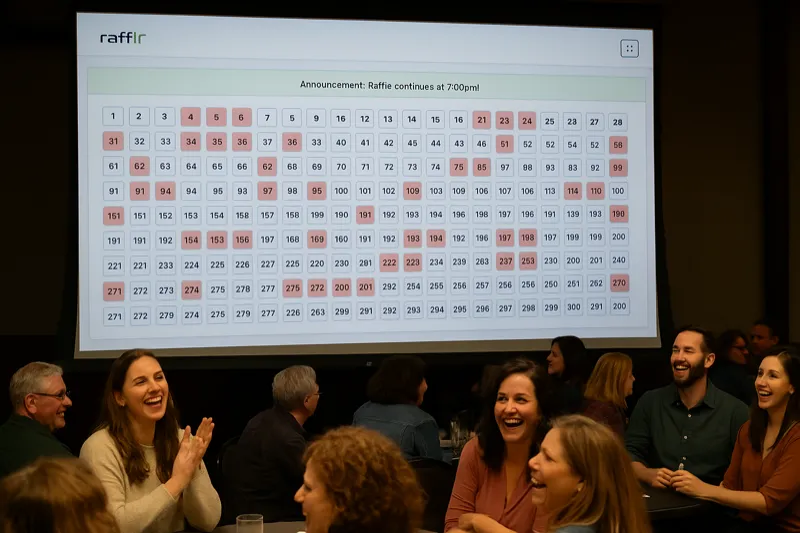
A reverse raffle transforms passive ticket holders into active participants in an unfolding drama. Every number drawn eliminates someone, and the tension ratchets up with each round. Participants track their numbers on a board, cheer when rivals are eliminated, groan when their own number appears, and negotiate buy-back decisions with their tablemates.
The social dynamics are what set reverse raffles apart. Tables become teams. Strangers become allies. The shared experience of surviving each round creates camaraderie that no traditional raffle can match. Organizations that switch to the reverse raffle format consistently report that attendance grows year over year because the event becomes a can't-miss tradition.
The drawdown format, which is essentially the same as a reverse raffle under a different name, has been a staple of community fundraising in the South for decades precisely because of this engagement factor.
Pros and Cons of Each Format
Traditional Raffle Pros
- Low barrier to entry: Cheap tickets mean almost anyone can participate, maximizing the number of people who feel included.
- Minimal planning: You need tickets, prizes, and something to draw numbers from. Setup takes minutes, not months.
- Flexible venue: Works indoors, outdoors, at existing events, or as a standalone. No special space required.
- Quick execution: The entire drawing can happen in under ten minutes, making it easy to fit into any event schedule.
- Low risk: With minimal upfront costs, there is very little financial risk even if ticket sales disappoint.
Traditional Raffle Cons
- Low revenue ceiling: Cheap tickets mean modest total revenue regardless of how many you sell.
- No secondary revenue: Once tickets are sold, there is no way to generate additional income during the event.
- Low engagement: Most participants are passive observers with a brief moment of hope during the drawing.
- No event loyalty: Traditional raffles rarely become the kind of must-attend event that builds year-over-year momentum.
- Prize pressure: You need attractive prizes to drive ticket sales, and those prizes eat into your already-thin margins.
Reverse Raffle Pros
- High revenue potential: Premium ticket prices and multiple revenue streams make five-figure fundraising nights routine.
- Buy-back revenue: A revenue stream that does not exist in any other raffle format, and one that participants actually enjoy.
- Maximum engagement: Every ticket holder is an active participant for the full duration of the event.
- Community building: The shared experience creates bonds between attendees that strengthen your organization's network.
- Annual tradition potential: Reverse raffles become signature events that people look forward to and plan around.
- Sponsorship appeal: The event format is attractive to corporate sponsors who want visibility at a high-energy community gathering.
Reverse Raffle Cons
- Higher planning effort: You need a venue, catering, AV equipment, and a larger volunteer team.
- Upfront costs: Venue rental, food, and prize money represent a real financial commitment before ticket sales begin.
- Smaller participant pool: Higher ticket prices mean fewer people can participate, which may not suit every community.
- Longer time commitment: The event requires a full evening, which is a bigger ask than a five-minute drawing.
- Technology needs: Managing hundreds of tickets, eliminations, and buy-backs manually is error-prone. Dedicated software makes a significant difference.
Which Format Is Best for Your Organization?
Choose a Traditional Raffle When...
- The raffle is a small add-on to an existing event, not the main attraction
- Your audience is price-sensitive and unlikely to spend more than twenty dollars
- You have limited planning time or volunteer resources
- You are running a casual community event like a picnic, carnival, or open house
- Your fundraising goal is under $5,000
Choose a Reverse Raffle When...
- You want the raffle to be the centerpiece of a dedicated fundraising event
- Your audience is willing to invest in a premium experience
- Your fundraising goal is $15,000 or higher
- You want to build an annual tradition that grows year over year
- You have a planning committee that can organize a dinner event
- You want multiple revenue streams beyond just ticket sales
Consider Running Both
Many experienced fundraising organizations run both formats at the same event. The reverse raffle serves as the main attraction with its premium tickets and sustained engagement. Meanwhile, traditional raffle baskets or a Chinese raffle table line the perimeter of the room, giving guests additional ways to participate and giving the organization additional revenue. This combination captures every budget level in the room and keeps the energy high between reverse raffle drawing rounds.
Real-World Revenue Scenarios
Scenario 1: Small Community Organization
A local volunteer fire department needs to raise money for new equipment. With a traditional raffle at their annual pancake breakfast, they might sell 400 tickets at $5 each for $2,000 in gross revenue. After $500 in prizes, they net $1,500.
Switch to a reverse raffle dinner event with 200 tickets at $75 each, and they gross $15,000. Add a $5,000 grand prize, $2,000 in food costs, and $1,000 in venue costs, and they still net $7,000. Add buy-backs and side pots, and the net climbs past $10,000. That is nearly seven times the revenue from the same community.
Scenario 2: School Booster Club
A high school booster club runs a traditional raffle at homecoming. They sell 1,000 tickets at $2 each for $2,000. Prizes cost $800, netting $1,200. It was a lot of work for a modest return.
An annual reverse raffle gala with 250 tickets at $150 each generates $37,500. Even with a $10,000 grand prize, $5,000 in catering, and $2,000 in venue costs, the net is over $20,000. Buy-backs and sponsorships can push it past $25,000. That funds an entire season of equipment, travel, and scholarships.
Scenario 3: Church or Parish
A church holds a traditional raffle after Sunday service, selling 300 tickets at $10 each for $3,000. Net after prizes: roughly $2,000. Respectable, but not transformative.
A reverse raffle dinner with 300 tickets at $100 each brings in $30,000. With $8,000 in total expenses, the church nets $22,000. Many parishes that have adopted the reverse raffle format report it becoming their single largest fundraising event of the year.
Making the Switch: Tips for Going Reverse
If you are currently running traditional raffles and considering a switch, here are practical steps to make the transition smooth:
- Start with a realistic ticket count. For your first reverse raffle, aim for 150 to 200 tickets. You can always grow the event in future years.
- Price tickets to include dinner. When guests feel they are getting a meal, entertainment, and a chance to win, $100 to $150 feels like a fair deal.
- Invest in presentation. A large display board or projector showing the ticket grid keeps everyone engaged and adds production value to the event.
- Plan for buy-backs. Decide in advance how many buy-backs to allow and at what price. This should be communicated to guests before the drawing begins.
- Use dedicated software. Managing a reverse raffle manually with paper tickets and a whiteboard works, but software eliminates errors, speeds up the drawing, and creates a more professional experience. Read our complete guide to running a reverse raffle for step-by-step planning advice.
Frequently Asked Questions
What is the main difference between a reverse raffle and a traditional raffle?
In a traditional raffle, winning numbers are drawn from a pool and the first number drawn wins. In a reverse raffle, numbers are eliminated one by one and the last ticket remaining wins the grand prize. This creates sustained suspense throughout the entire event rather than a single moment of excitement.
Which type of raffle raises more money for fundraising?
Reverse raffles typically raise significantly more money than traditional raffles. With higher ticket prices ($50-$250 vs $1-$20), buy-back opportunities, and side pots, a 300-ticket reverse raffle can generate $15,000-$75,000 compared to a traditional raffle's typical $2,000-$10,000.
Can I run both a reverse raffle and a traditional raffle at the same event?
Yes, many organizations run a reverse raffle as the main event and supplement it with traditional raffle baskets or a Chinese raffle table. This combination maximizes revenue by appealing to different budget levels and keeps guests engaged throughout the evening.
How many tickets should I sell for a reverse raffle vs a traditional raffle?
Reverse raffles typically sell 100 to 500 tickets at higher price points. Traditional raffles may sell hundreds or thousands of low-cost tickets. For a reverse raffle, 200 to 300 tickets is the sweet spot that balances revenue with event duration and excitement.
Is a reverse raffle harder to organize than a traditional raffle?
Reverse raffles require more planning since they are typically part of a dinner event, but modern software like rafflr automates the drawing process, ticket tracking, and buy-back management. The additional planning effort is well worth it given the significantly higher revenue potential.
The Bottom Line
Traditional raffles and reverse raffles are both legitimate fundraising tools, but they operate at fundamentally different scales. A traditional raffle is a simple, low-effort way to add a few thousand dollars to an existing event. A reverse raffle is a premium fundraising experience that can generate tens of thousands of dollars in a single evening while building community bonds and creating annual traditions.
For organizations serious about maximizing fundraising revenue, the reverse raffle is the clear winner. The higher planning effort pays for itself many times over in ticket sales, buy-back revenue, and sponsorship opportunities. And with the right software handling the logistics, running a reverse raffle is far easier than it used to be.