Raffles are one of the most reliable fundraisers a PTA or PTO can run. They require less volunteer time than a bake sale, less overhead than a carnival, and they generate excitement that keeps parents coming back year after year. Whether your parent group is new to raffles or looking to improve on last year's event, this guide covers everything from prize ideas to budget planning to the drawing itself.
Why PTAs and PTOs Love Raffles
Ask any experienced PTA board member about their go-to fundraiser, and raffles will be near the top of the list. There are several reasons parent groups keep returning to this format.
Parent engagement is built in. Unlike passive fundraisers where families just write a check, raffles give people something to look forward to. The anticipation of a drawing, the chance to win something valuable, and the social element of buying tickets at school events all create genuine engagement. Parents who might skip a silent auction will happily buy a few raffle tickets.
Volunteers do not need special skills. Running a raffle does not require auctioneering talent, culinary expertise, or event production experience. A small committee can handle prize collection, ticket sales, and the drawing with minimal training. That matters when your volunteer pool rotates every year as families move through the school.
The format is repeatable. Once your PTA runs a successful raffle, you have a template for next year. Refine the prize list, adjust ticket prices, and improve your promotion strategy. Many PTAs run two or three raffles per school year because the format scales so well. For a deeper look at planning logistics, our complete raffle planning checklist walks through the full process.
Profit margins are high. When prizes are donated by local businesses or parent-owned companies, your costs drop close to zero. Even raffles with purchased prizes routinely return 60-80% profit margins because ticket revenue far exceeds prize costs.
10 PTA and PTO Raffle Prize Ideas
The prizes you offer determine how many tickets you sell. Here are ten categories that consistently perform well for school parent groups.
1. Themed Gift Baskets
Assign each classroom a theme and have families contribute items. A "Movie Night" basket might include streaming gift cards, popcorn, candy, and a cozy blanket. A "Date Night" basket could have restaurant gift cards, chocolates, and a candle. Baskets feel generous because they contain multiple items, even when the total cost per family is just $5-10.
2. Restaurant Gift Card Bundles
Approach local restaurants for donated gift cards and bundle them together. A "$200 Local Dining Package" with four $50 cards from different restaurants is a crowd-pleaser. Restaurants benefit from the exposure, and parents love the practicality.
3. Experience Prizes
Experiences often outperform physical items. Think spa day packages, family photo sessions, cooking classes, escape room vouchers, or tickets to local attractions. Parents with a parent-owned business can donate services like landscaping, house cleaning, or tutoring sessions.
4. Tech Bundles
A tablet, wireless earbuds, or a smart home device will drive ticket sales. If your budget allows purchasing one marquee tech prize, it can serve as the headline item that gets people buying tickets. Pair it with donated accessories for a complete package.
5. Principal for a Day
This costs the PTA nothing and kids go wild for it. The winning student gets to shadow the principal, make morning announcements, and maybe even assign extra recess. It is one of those school-specific prizes that generates buzz far beyond its cost.
6. Reserved Parking Spot
At schools with competitive drop-off lines, a reserved front-row parking spot for a semester is surprisingly valuable. Again, it costs the PTA nothing but requires coordination with the school administration.
7. Summer Camp Scholarships
Partner with local camps to offer a free week of summer camp. Many camps will donate a spot as marketing, and parents see real value in a prize worth $300-500. This works especially well for spring raffles when summer planning is on everyone's mind.
8. Sports and Recreation Packages
Tickets to professional or college sporting events, a family pass to the local pool or rec center, or a set of sports equipment. These appeal to active families and are often easy to get donated from local sports organizations.
9. Classroom Privileges Package
Work with teachers to offer prizes like "homework pass for a week," "sit in the teacher's chair for a day," or "choose the class read-aloud." These cost nothing but are incredibly motivating for students, which means parents buy tickets on their behalf.
10. Cash or Tuition Credit
Sometimes the simplest prize is the most effective. A cash prize or credit toward school fees (field trips, yearbooks, activity fees) has universal appeal. If your school charges for any optional programs, a credit toward those costs can be a strong motivator. For guidance on setting the right ticket prices relative to your prizes, see our guide on how to price raffle tickets.
See rafflr in Action
Watch a 2-minute demo of how easy it is to create and run a reverse raffle with rafflr
How to Run a PTA Raffle Step by Step
A successful PTA raffle fundraiser follows a predictable sequence. Here is the process from start to finish.
Step 1: Form a Raffle Committee
You need three to five volunteers with clear roles. Designate a committee chair to coordinate everything, a prize coordinator to solicit and collect donations, a ticket sales lead to manage distribution and tracking, and a treasurer to handle money. Having defined roles prevents the classic PTA problem of one person doing all the work.
Step 2: Get Principal and District Approval
Before you spend a single hour planning, confirm that your school administration and district support the raffle. Some districts have specific policies about fundraising activities on school grounds. Get approval in writing and ask about any restrictions on ticket sales during school hours, prize types, or promotional materials.
Step 3: Check Legal Requirements
Raffle laws vary significantly by state. Some states require permits, others exempt nonprofits, and a few prohibit raffles entirely. Your PTA's nonprofit status may affect what is required. Contact your state PTA organization for guidance since they typically maintain resources on local fundraising regulations. Our school raffle software page also covers compliance basics for educational organizations.
Step 4: Set Your Budget and Goals
Decide how much you want to raise and work backward. If your goal is $3,000 in net revenue and you plan to spend $500 on prizes and $200 on supplies, you need $3,700 in ticket sales. At $10 per ticket, that means selling 370 tickets. At a school with 400 families, that is achievable if most families buy at least one.
Step 5: Collect Prizes
Start soliciting donations 4-6 weeks before your sales period. Create a simple one-page letter explaining the raffle, where the money goes, and the tax-deductible nature of donations. Send it to local businesses, and ask parent volunteers to approach businesses they have relationships with. Personal connections convert far better than cold outreach.
Step 6: Set Ticket Prices and Sales Channels
Price tickets based on your audience and prize value. For most PTAs, $5 to $25 per ticket (or bundles like 5 for $20) hits the sweet spot. Sell tickets through multiple channels: in-person at school events, at morning drop-off, and through an online platform. The more convenient you make purchasing, the more tickets you sell.
Step 7: Promote the Raffle
Use every communication channel your PTA has. School newsletters, email blasts, social media groups, flyers in backpacks, and announcements at school events. Feature the prizes prominently since people buy tickets because they want to win something specific. Create urgency with a clear sales deadline.
Step 8: Run the Drawing
Make the drawing an event, not an afterthought. Hold it at a school gathering like a family fun night, open house, or end-of-year celebration. Use a digital raffle tool to run a professional drawing that builds suspense. If you are looking for ideas beyond a standard raffle, browse our school fundraising ideas for formats like reverse raffles that add even more excitement.
Step 9: Notify Winners and Distribute Prizes
Contact winners promptly and arrange prize pickup. Post winners on your PTA social media (with permission) to build excitement for the next raffle. Send thank-you notes to all businesses that donated prizes since you want them to say yes again next year.
Step 10: Document Everything
Record what worked, what did not, which prizes sold the most tickets, and your final revenue numbers. This documentation is invaluable for next year's committee. Include a financial summary for your PTA board and membership.
Tips for Maximizing Parent Participation
The biggest variable in your raffle's success is participation. Here is how to get more families involved.
Make it personal. Generic emails get ignored. When a classroom parent sends a message saying "Our class basket needs three more items by Friday," response rates jump. Assign grade-level coordinators who reach out directly to families in their grade.
Offer a bundle deal. Single-ticket prices feel like gambling. Bundle pricing (1 ticket for $10 or 3 for $25) makes families feel like they are getting a deal and increases average spend. Some PTAs offer an "all-in" package that enters the family into every prize category.
Create friendly competition. Track ticket sales by classroom and offer a small reward (extra recess, pizza party) to the class with the highest participation rate. Notice that is participation rate, not total dollars, so smaller classes are not disadvantaged.
Sell at every event. Have tickets available at back-to-school night, parent-teacher conferences, school performances, and sporting events. Impulse buying drives a significant portion of ticket sales, so be where parents already are.
Use visuals. Display the actual prizes (or photos of them) prominently wherever you sell tickets. A table with gift baskets and a sign showing the tech prize generates more sales than a printed list ever will.
Send reminders. People intend to buy tickets and then forget. Send reminders at the halfway point and two days before the deadline. A "Last chance to buy tickets" message on the school's social media page consistently drives a final surge in sales.
Legal Considerations for School Raffles
Running a raffle at a school comes with specific legal responsibilities that your committee needs to address before selling a single ticket.
State raffle laws. Every state regulates raffles differently. Some require permits, some limit prize values, and some restrict who can operate a raffle. California, for example, requires nonprofits to register with the Attorney General's office. Texas allows charitable raffles but has specific reporting requirements. A few states like Alabama, Hawaii, and Utah have significant restrictions on raffle activities.
Nonprofit status matters. Most PTA chapters are registered 501(c)(3) nonprofits through their state PTA organization. This status often qualifies you for exemptions or simplified permitting. Verify your chapter's nonprofit status is current before planning a raffle.
Age restrictions on ticket sales. Most states prohibit minors from selling raffle tickets. Even where it is technically allowed, many school districts have policies against it. Plan for adult volunteers to handle all sales.
Prize reporting. Raffle prizes over $600 in value may require the winner to report the winnings as income. For high-value prizes, consult with a tax professional about reporting obligations. Most PTA raffles stay well under this threshold.
Free entry requirements. Some states require that you offer a free method of entry (known as "no purchase necessary" or AMOE - alternate method of entry). Even if your state does not require it, offering a free entry option protects your PTA from legal challenges.
Budget Planning: Costs and Expected Returns
Understanding the financial picture helps your committee set realistic goals and make smart spending decisions. Here is what a typical PTA raffle budget looks like.
Typical Expenses
- Purchased prizes: $0-$500 (lower if most prizes are donated)
- Printing (tickets, flyers, signage): $50-$150
- Raffle software or platform: $0-$100
- Basket supplies (cellophane, ribbon, containers): $30-$75
- Miscellaneous (thank-you cards, postage): $20-$50
Total typical expenses: $100-$875
Revenue Scenarios by School Size
These estimates assume $10 average ticket price and moderate participation.
- Small school (150 families): 60% participation = 90 families x $20 avg spend = $1,800 gross revenue
- Medium school (350 families): 50% participation = 175 families x $25 avg spend = $4,375 gross revenue
- Large school (600+ families): 40% participation = 240 families x $30 avg spend = $7,200 gross revenue
Notice that larger schools often have lower participation rates but higher per-family spending. The key metric is not just how many families buy tickets but how much each family spends. Bundle pricing and multiple prize tiers help increase average spend.
Maximizing Your Return
The single most effective way to improve your raffle's profitability is to increase the percentage of donated prizes. A raffle where 100% of prizes are donated can return 85-95% of ticket revenue as profit. Invest your committee's time in prize solicitation rather than prize purchasing.
Second, move ticket sales online. Digital ticket sales eliminate printing costs, reduce volunteer hours at sales tables, and make it easy for busy parents to buy tickets on their phone at 10pm. Many PTAs report that adding online sales increases total ticket revenue by 30-50%.
Frequently Asked Questions
Do PTAs need a license to run a raffle?
It depends on your state. Many states require a raffle permit or license, even for school-affiliated nonprofit organizations. Some states exempt PTAs if the raffle is small or the proceeds go directly to educational purposes. Check with your state's gaming commission or attorney general's office before selling tickets.
How much money can a PTA raffle raise?
A well-run PTA raffle typically raises between $1,000 and $10,000 depending on school size, prize value, and ticket pricing. Schools with 300-500 families that sell tickets at $5-$25 each and secure donated prizes can expect net profits of $2,000 to $5,000 after expenses.
What are the best prizes for a PTA raffle?
The best PTA raffle prizes appeal to parents and families. Top performers include themed gift baskets, restaurant gift card bundles, experience packages (spa days, family outings), tech items, and principal-for-a-day experiences for kids. Donated prizes maximize your profit margin since there is no cost to the PTA.
Can students sell raffle tickets?
Most states prohibit minors from selling raffle tickets. Even in states that allow it, many school districts have policies against student-to-student sales. The safest approach is to have parent volunteers handle all ticket sales at school events, through online platforms, or at designated pickup and drop-off times.
How far in advance should we plan a PTA raffle?
Plan at least 6 to 8 weeks in advance. You will need 1-2 weeks for committee formation and approvals, 2-3 weeks for prize solicitation and donation collection, 2-3 weeks for ticket sales, and a few days for the drawing event itself. Starting earlier gives you more time to secure donated prizes and promote the raffle to families.
Make Your Next PTA Raffle a Success
A PTA raffle fundraiser works because it combines simplicity with excitement. Parents enjoy the chance to win something, volunteers appreciate the manageable workload, and your school benefits from the funds raised. Start with donated prizes, price your tickets thoughtfully, promote through every channel available, and make the drawing itself a memorable event.
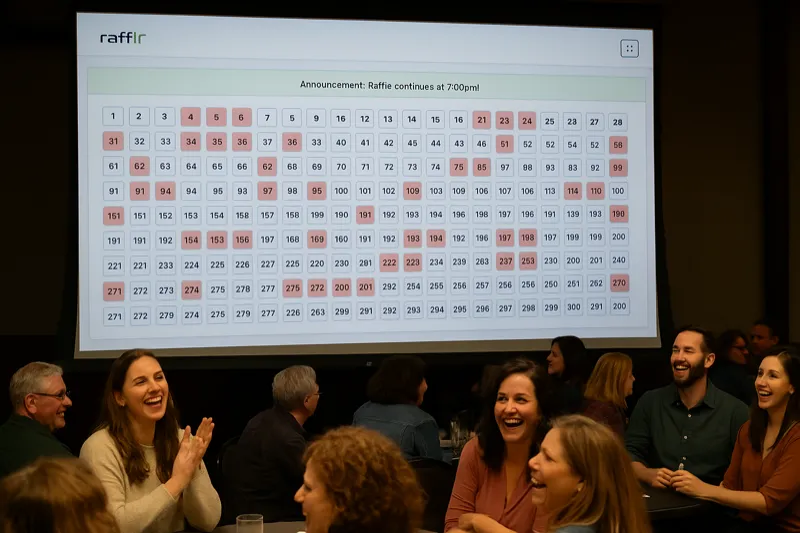
If you are ready to run a professional raffle drawing at your next school event, explore how rafflr helps schools present the live draw with number tracking, sponsor recognition, and a projector-ready board. Ticket sales and participant payments remain outside rafflr.