The raffle software market has grown significantly heading into 2026. Whether you are running a charity gala, a school fundraiser, or a reverse raffle night, there is a platform built for your specific use case. This guide compares the ten best raffle software platforms available right now, with honest assessments of pricing, strengths, and limitations to help you make the right choice.
What Has Changed in Raffle Software for 2026
The raffle software landscape looks different than it did even a year ago. Several trends are shaping the platforms available to organizers in 2026:
- Hybrid event support is now standard. Most platforms let you sell tickets online and manage drawings in person, reflecting the reality that many events blend both formats.
- Lower transaction fees across the board. Competition has pushed platforms to reduce or eliminate percentage-based fees, though some still charge 5% or more.
- Better presentation tools. Organizers expect more than a random number generator. Live displays, animated drawings, and audience-facing screens are increasingly common.
- Compliance features are improving. More platforms include tools for managing raffle laws and permit requirements that vary by state.
- Mobile-first design. Ticket buyers expect to purchase and track entries from their phones without friction.
If you are looking for a deeper dive into what raffle software does and who needs it, our raffle software buyer's guide covers the fundamentals. This post focuses specifically on how the top platforms compare in 2026.
Quick Comparison: 10 Best Raffle Software Platforms
Here is a side-by-side overview of the ten platforms we evaluated. Scroll right on mobile to see all columns.
| Platform | Best For | Price Range | Key Strength | Key Weakness |
|---|---|---|---|---|
| Rafflr | Reverse raffles, in-person events | $77/event, $97/yr, $497 lifetime | Easiest setup, live presenter display | Focused on reverse raffles, not online ticket sales |
| RallyUp | Online fundraising campaigns | Free + 5% fee, or $79/mo | Full fundraising suite (auctions, raffles, crowdfunding) | Expensive for raffle-only use |
| Zeffy | Budget-conscious nonprofits | Free (tip-based) | Truly free for nonprofits | Limited customization, relies on donor tips for revenue |
| Rafflecopter | Online giveaways, social media promotions | Free - $84/mo | Easy embeddable widget, social integrations | Not designed for in-person events or ticket sales |
| RRaffle | Simple random drawings | Free - $10/mo | Lightweight, quick setup | Very limited features, basic interface |
| RandomPicker | Verified random selections | Free - $59 per drawing | Certified random algorithm, audit trail | No ticket selling or event management features |
| PayBee | Full-service fundraising galas | $499+/event | All-in-one event platform (auctions, raffles, donations) | High price point for small organizations |
| Club Raffle | Sports clubs and community groups | Free - $29/mo | Built for recurring club raffles | Niche focus limits broader use cases |
| GalaBid | Charity auctions with raffle add-ons | $199+/event | Strong silent auction tools | Raffle features are secondary to auction capabilities |
| Raffall | UK-based online raffles | Free + 5% fee | Built-in audience and marketplace | UK-focused, limited outside the UK market |
Detailed Reviews
1. Rafflr
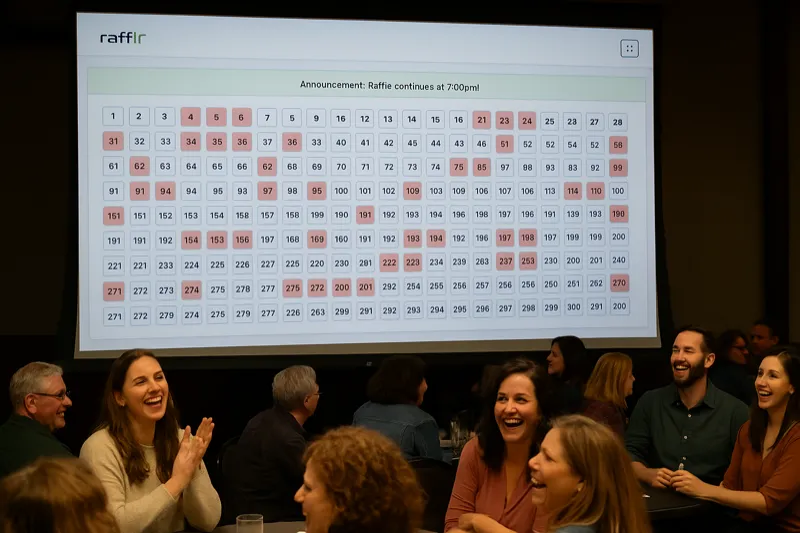
Rafflr is purpose-built for reverse raffles and in-person raffle events. Where other platforms try to be everything to everyone, Rafflr focuses on doing one thing exceptionally well: making it easy to set up, run, and display a professional raffle drawing in front of a live audience.
The setup takes minutes rather than hours. You enter your ticket count, customize your settings, and launch directly into a full-screen presenter view designed for projectors and large displays. The software handles the drawing logic, tracks eliminated numbers, and creates genuine suspense as the field narrows to a winner.
At $97 per year for unlimited raffles, the pricing is straightforward with no transaction fees. The limitation is that Rafflr is not an online ticket-selling platform. It is designed for organizations that sell tickets through their own channels and need professional software to run the actual drawing event. If that matches your use case, it is hard to beat.
2. RallyUp
RallyUp is a full fundraising platform that includes raffles alongside auctions, crowdfunding, and peer-to-peer campaigns. For organizations running large online fundraising events with multiple components, RallyUp provides a unified dashboard to manage everything.
The raffle module supports online ticket sales, automatic winner selection, and compliance features. However, the pricing reflects its broader scope. The free tier charges a 5% platform fee on top of payment processing, and the paid plan starts at $79 per month. If you only need raffle functionality, you are paying for a lot of features you will not use.
3. Zeffy
Zeffy has carved out a unique position by offering a completely free platform for nonprofits. There are no subscription fees, no platform fees, and no transaction fees charged to the organization. The platform sustains itself through optional tips that donors can add during checkout.
For nonprofits watching every dollar, this model is compelling. The raffle tools are functional if basic: online ticket sales, random drawing, and donor management. The trade-off is limited customization and the fact that some donors may feel pressured by the tip prompt, which could affect the giving experience.
See rafflr in Action
Watch a 2-minute demo of how easy it is to create and run a reverse raffle with rafflr
4. Rafflecopter
Rafflecopter pioneered the embeddable giveaway widget and remains one of the most recognizable names in online promotions. It integrates with social media platforms to drive engagement, making it ideal for brands running giveaways where entries come through actions like following an account or sharing a post.
The free plan supports basic giveaways. Paid tiers add features like email validation, fraud detection, and recurring giveaways. Where Rafflecopter falls short is anything involving real money. It does not handle ticket sales, payment processing, or in-person event management. It is a promotional tool, not fundraising software.
5. RRaffle
RRaffle keeps things simple. It is a lightweight tool for running basic random drawings without the overhead of a full event platform. You enter names or numbers, hit draw, and get a winner. The interface is clean and the learning curve is essentially zero.
The free tier handles small drawings. The paid plan at around $10 per month adds features like custom branding and larger participant limits. RRaffle works when you need a quick, no-frills random selection. It does not work when you need ticket management, payment processing, live displays, or any form of event orchestration.
6. RandomPicker
RandomPicker differentiates itself with a focus on verifiable randomness. The platform provides a certified random number generator with a complete audit trail, which matters for organizations that need to demonstrate the fairness of their drawing for legal or regulatory reasons.
Pricing is per-drawing rather than subscription-based, starting free for small drawings and scaling up to $59 for large ones. The platform is purely a drawing tool. It does not sell tickets, manage events, or provide presentation features. Think of it as the certified independent auditor of raffle drawings. For a broader look at raffle drawing tools and how they compare, see our dedicated comparison.
7. PayBee
PayBee positions itself as an all-in-one fundraising event platform. It handles live and silent auctions, raffles, donation appeals, and event management from a single dashboard. The platform includes tools for live streaming, real-time donation tracking, and post-event analytics.
The raffle component is solid but is clearly one piece of a much larger platform. Pricing starts at $499 per event, which makes sense for organizations running major galas with six-figure fundraising goals. For a simple raffle night, the cost and complexity are overkill.
8. Club Raffle
Club Raffle is built specifically for sports clubs, community groups, and member organizations that run regular raffles. The platform supports recurring drawings, member management, and automated communications that make weekly or monthly raffles easy to manage.
The pricing is accessible, with a free tier for small clubs and paid plans starting at $29 per month. The limitation is the narrow focus. If you are not running regular club-style raffles, the feature set may not match your needs. One-off charity events or large-scale fundraisers would be better served by other platforms.
9. GalaBid
GalaBid is primarily a silent auction platform that includes raffle functionality as part of its event toolkit. For organizations hosting charity galas where silent auctions and raffles run alongside each other, having both in one platform reduces complexity.
The auction tools are polished, with mobile bidding, real-time leaderboards, and post-event settlement. The raffle features, while functional, get less attention and fewer updates than the auction side of the platform. Pricing starts at $199 per event, positioning it for mid-to-large organizations.
10. Raffall
Raffall operates primarily in the UK market, providing an online raffle platform with a built-in marketplace where hosts can list their raffles for additional exposure. The platform handles ticket sales, random drawing, and winner notification.
The free-to-list model with a 5% commission on sales makes it accessible to start. The built-in audience is a genuine advantage for hosts who lack their own marketing channels. The downside is geographic focus. Raffall is designed around UK raffle regulations and payment systems, making it less practical for US-based organizations.
How to Choose Raffle Software
With ten platforms to consider, narrowing the field starts with understanding your specific situation. Here are the criteria that matter most:
Event Format
This is the single most important factor. In-person events need presentation displays, audience-facing screens, and live drawing capabilities. Online events need ticket selling, payment processing, and automated winner selection. Some platforms handle both, but most are stronger in one area. Rafflr dominates in-person events. RallyUp and Zeffy are stronger online.
Budget and Pricing Model
Pricing models vary dramatically. Some charge flat monthly or annual fees. Others take a percentage of every transaction. A platform that charges 5% looks cheap until you realize it costs $500 on a $10,000 raffle. For high-revenue events, flat-fee platforms like Rafflr save money. For occasional small drawings, free or pay-per-use options like RandomPicker make more sense.
Ticket Sales Capabilities
If you need the software to handle ticket sales and payment processing, your options narrow. Platforms like RallyUp, Zeffy, and Raffall include built-in ticket selling. Platforms like Rafflr, RandomPicker, and RRaffle assume you handle ticket sales separately. Neither approach is wrong, but the distinction matters for your workflow.
Compliance and Reporting
Raffle laws vary significantly by state and country. If your organization needs audit trails, financial reporting, or documentation for regulatory compliance, look for platforms that provide those tools natively. RandomPicker's certified audit trail and RallyUp's reporting capabilities stand out here.
Ease of Use
The person running your raffle may not be technically inclined. Platforms that require extensive configuration, training, or technical setup create friction. Rafflr and Rafflecopter score highest on ease of use. PayBee and GalaBid require more onboarding due to their broader feature sets.
Free vs. Paid Raffle Software
The appeal of free raffle software is obvious, but there are important trade-offs to understand before choosing a free platform over a paid one.
What Free Gets You
Free platforms like Zeffy and the free tiers of Rafflecopter and RRaffle provide basic functionality: a way to collect entries and select a winner. For simple giveaways, casual office drawings, or very small community events, free tools work fine.
What Free Costs You
Free platforms make money somewhere. Zeffy relies on donor tips, which can create awkward moments during checkout. Other "free" platforms charge percentage-based fees that scale with your event's success. A 5% fee on a $20,000 raffle is $1,000, far more than a year of most paid subscriptions.
Beyond direct costs, free platforms typically offer limited customization, minimal support, and fewer features. If your raffle is a significant fundraising event with an audience of hundreds, the presentation quality and reliability of paid software pays for itself.
When to Pay
Pay for raffle software when any of the following are true:
- Your event raises more than $2,000 (percentage fees will exceed subscription costs)
- You need a professional live presentation for an audience
- You run multiple raffles per year and want a consistent, reliable tool
- Compliance, reporting, or audit trails are required by your organization or state
- Customer support matters because your event cannot afford technical failures
Our Top Pick for 2026
There is no single best raffle software for everyone, but we can make clear recommendations based on use case.
For reverse raffles and in-person events: Rafflr is the clear winner. No other platform matches its combination of setup speed, live presentation quality, and straightforward pricing. The full-screen presenter display with animated number elimination creates genuine excitement that a basic random number generator simply cannot replicate. At $97 per year with no per-event or per-transaction fees, it is also one of the most cost-effective options for organizations that run regular events.
For online fundraising raffles: RallyUp offers the most complete feature set, though Zeffy is the better value if your organization qualifies for its free nonprofit plan.
For social media giveaways: Rafflecopter remains the standard for online promotional giveaways.
For simple random drawings: RandomPicker delivers certified randomness with minimal overhead.
The right software depends entirely on what kind of raffle you are running. If you want to explore which type of raffle format works best for your event, our guide on choosing the best raffle app breaks down the options further.
Frequently Asked Questions
What is the best raffle software in 2026?
It depends on your use case. Rafflr is the top choice for reverse raffles and in-person events. RallyUp excels at online peer-to-peer fundraising. Zeffy is best for nonprofits who need a completely free platform. For simple random drawing, RandomPicker offers a no-frills solution.
Is there free raffle software available?
Yes. Zeffy offers a completely free fundraising platform funded by optional donor tips. RandomPicker has a free tier for basic drawings. Most other platforms like Rafflecopter and Club Raffle offer limited free plans with paid upgrades for full features.
What should I look for when choosing raffle software?
The most important factors are your event format (in-person vs. online), ticket selling capabilities, payment processing fees, presentation and display features, compliance tools for raffle laws, customer support quality, and whether the platform integrates with your existing tools.
How much does raffle software typically cost?
Pricing varies widely. Free options exist with limited features. Mid-range platforms cost $10 to $50 per month. Premium platforms with full event management features can run $99 to $500+ per month, often with additional per-transaction fees ranging from 2% to 8%.
Can I run a raffle legally with software?
Raffle legality depends on your state or country, not the software you use. Most U.S. states allow raffles for registered nonprofits with proper permits. Some states prohibit raffles entirely. Good raffle software helps with compliance by tracking ticket sales, generating reports, and maintaining audit trails, but you are responsible for following local raffle laws.
Get Started
If you are planning a reverse raffle or in-person drawing event, get started with rafflr today and see why organizations across the country trust it for their most important fundraising nights. Setup takes less than five minutes, and you will have a professional-quality raffle experience your audience will remember.