Selling raffle tickets online opens up your fundraiser to a much wider audience than in-person sales alone. Whether you are a school booster club, a church group, or a nonprofit running a major gala, moving ticket sales to the web can dramatically increase revenue and reduce the logistical headaches of cash handling and paper ticket tracking. This guide covers everything you need to know: the best platforms, legal requirements, payment processing, pricing strategies, and how to make the drawing itself memorable.
Why Sell Raffle Tickets Online?
Traditional raffle ticket sales rely on volunteers standing at tables, handling cash, and manually tracking who bought what. That approach works for small events, but it places a hard ceiling on your fundraising potential. When you sell raffle tickets online, you remove geographic barriers and make it easy for supporters who cannot attend in person to participate.
Organizations that move to online ticket sales typically see a 30-50% increase in total tickets sold, according to fundraising industry data. The reasons are straightforward:
- 24/7 availability -- supporters can buy tickets at any time, not just during business hours or at the event
- Wider reach -- share your raffle link on social media, email, and text messages to reach people far beyond your local community
- Easier payment -- credit card payments mean no more counting cash or chasing down checks
- Automatic tracking -- every sale is recorded with buyer information, eliminating manual data entry
- Bundle pricing -- platforms make it easy to offer discounted multi-ticket packages that increase average order value
If you are new to running raffles in general, our complete guide to online raffles covers the fundamentals of planning and executing a successful raffle event from start to finish.
Legal Requirements for Selling Raffle Tickets Online
Before you set up a single ticket listing, you need to understand the legal landscape. Raffles are legally classified as a form of gambling in most states, and selling tickets online adds layers of complexity that do not exist with in-person sales.
State-by-State Regulations
Every state has different rules about who can run a raffle, how tickets can be sold, and what reporting is required. Here are the key considerations:
- Who can run a raffle? Most states restrict raffles to qualified nonprofits, charities, religious organizations, and fraternal groups. For-profit businesses generally cannot run raffles.
- Online sales restrictions: Some states allow online ticket sales statewide, while others require tickets to be sold only at specific locations. A handful of states prohibit online raffle ticket sales entirely.
- Permit requirements: Many states require a raffle license or permit before you can sell tickets. Processing times vary from same-day to several weeks.
- Prize value limits: Some states cap the total value of prizes you can offer in a single raffle or per year.
- Reporting obligations: Winners above certain thresholds (typically $600) must be reported to the IRS on Form W-2G. Some states require additional reporting.
For a detailed breakdown of raffle regulations in your state, see our online raffle laws guide, which covers requirements across all 50 states.
Multi-State Considerations
Selling raffle tickets online means you could potentially sell to buyers in any state. This creates a jurisdictional challenge: you may need to comply with the laws of every state where a buyer resides. Many organizations handle this by:
- Restricting sales to residents of their own state only
- Using geofencing on their ticket platform to block purchases from prohibited states
- Including clear terms and conditions that specify eligible states
- Requiring buyers to confirm their state of residence during checkout
Free Entry Requirements
Several states require that you offer an alternative method of entry (AMOE) that does not require a purchase. This typically means providing a mail-in option or free online entry form. Even if your state does not require it, offering an AMOE can help protect your organization from legal challenges. Include clear instructions for the free entry method on your raffle page and in your official rules.
See rafflr in Action
Watch a 2-minute demo of how easy it is to create and run a reverse raffle with rafflr
Top Platforms for Selling Raffle Tickets Online
Choosing the right platform is one of the most important decisions you will make. The platform you select determines your buyer experience, fee structure, and available features. Here is a detailed comparison of the most popular options.
Platform Comparison Table
| Platform | Best For | Platform Fee | Payment Processing | Key Features |
|---|---|---|---|---|
| Zeffy | Nonprofits wanting zero fees | 0% (donor-funded) | Stripe (0%) | Free for nonprofits, donation-based model, simple setup |
| RallyUp | Complex fundraising campaigns | 5% or flat monthly | Stripe (2.9% + $0.30) | Multiple raffle types, peer-to-peer, auction combos |
| TicketSpice | Polished buyer experience | $0.99/ticket | Stripe (2.9% + $0.30) | Custom branding, embeddable widgets, fast checkout |
| Galabid | Galas and live events | Custom pricing | Integrated (varies) | Auction + raffle combo, live event tools, text-to-bid |
| BetterWorld | Small to mid-size nonprofits | 0% platform fee | Stripe (2.9% + $0.30) | Raffles, auctions, crowdfunding in one platform |
| Eventbrite | Event-based ticket sales | 3.7% + $1.79/ticket | Integrated | Large marketplace, event management, mobile app |
| rafflr | Live raffle drawings | Annual subscription | N/A (drawing only) | Professional live drawing, reverse raffle, presenter mode |
Zeffy: Best Free Option for Nonprofits
Zeffy stands out as the only truly free platform for nonprofits. They charge zero platform fees and zero payment processing fees by asking donors to leave an optional tip during checkout. If your organization is a registered 501(c)(3), Zeffy is hard to beat on cost. The trade-off is that the platform is simpler than some competitors and the optional tip prompt can occasionally confuse buyers.
RallyUp: Best for Feature-Rich Campaigns
RallyUp offers the most comprehensive feature set for online fundraising. Beyond basic raffle ticket sales, you can combine raffles with auctions, crowdfunding, and peer-to-peer campaigns in a single event page. Their raffle-specific features include automatic winner selection, ticket bundles, early-bird pricing, and real-time sales tracking. The 5% platform fee is higher than competitors, but organizations running large campaigns often find the ROI justifies the cost.
TicketSpice: Best Buyer Experience
TicketSpice focuses on creating a smooth, branded checkout experience. Their per-ticket pricing ($0.99/ticket) makes costs predictable, and the platform allows deep customization of your ticket page with your organization's branding. TicketSpice also offers embeddable widgets that let you sell tickets directly from your own website without redirecting buyers to a third-party page.
Where rafflr Fits In
rafflr is not a ticket sales platform. It specializes in the drawing itself, specifically reverse raffles and drawdowns where numbers are eliminated one by one in a live presentation. Many organizations use a ticket selling platform like Zeffy or RallyUp to handle sales and payments, then use rafflr to run the actual drawing at their event. This combination gives you the best of both worlds: professional online ticket sales paired with an exciting, suspenseful live drawing experience. Learn more about how digital raffle tickets work with modern drawing software.
Payment Processing: What You Need to Know
Payment processing is where many organizations get tripped up. Understanding fees, payout timelines, and compliance requirements will save you headaches down the road.
Credit Card Processing Fees
Most raffle ticket platforms use Stripe as their payment processor. The standard Stripe rate is 2.9% + $0.30 per transaction. On a $20 ticket purchase, that means $0.88 goes to processing fees. Here is what that looks like at different price points:
- $10 ticket: $0.59 in fees (5.9% effective rate)
- $25 ticket: $1.03 in fees (4.1% effective rate)
- $50 ticket: $1.75 in fees (3.5% effective rate)
- $100 ticket: $3.20 in fees (3.2% effective rate)
Notice that the effective rate decreases as ticket price increases. This is why encouraging buyers to purchase ticket bundles is so valuable. Selling one $50 bundle instead of five $10 individual tickets saves you $2.20 in processing fees.
Absorb vs. Pass Through Fees
You have two options for handling processing fees:
- Absorb the fees: Your organization pays all processing costs. Buyers see a clean price. This is the most common approach for raffles and is generally recommended because it keeps the purchase simple.
- Pass through fees: Add processing fees to the buyer's total at checkout. This preserves your margins but can reduce conversion rates, especially for lower-priced tickets where the fee feels disproportionate.
Payout Timelines
Most platforms hold funds for 2-7 business days after a sale before transferring to your bank account. Some platforms offer faster payouts for an additional fee. Plan your event budget accordingly. If you need prize money before the payout arrives, you will need to front those costs from your operating budget.
Platforms to Avoid for Payment
Do not use PayPal, Venmo, Cash App, or Zelle as your primary payment method for raffle tickets. These platforms have terms of service that restrict gambling-related transactions, and raffles often fall into that category. Using them puts you at risk of having your account frozen and funds held. Stick with dedicated raffle platforms that use Stripe or similar payment processors designed for this use case.
Digital vs. Physical Raffle Tickets
One of the biggest decisions you will face is whether to use digital tickets, physical tickets, or a hybrid approach. Each has distinct advantages depending on your event format.
Digital Tickets
Digital raffle tickets are delivered via email or accessible through an online account. They are the default for online sales and offer several advantages:
- Zero printing costs -- no paper, no ink, no design fees
- Instant delivery -- buyers receive their tickets immediately after purchase
- Easy tracking -- all sales data is automatically recorded in your platform
- Environmentally friendly -- no waste from unused or discarded tickets
- Fraud prevention -- digital tickets cannot be counterfeited or duplicated
The main downside of digital tickets is that some audiences, particularly older demographics, may be less comfortable with them. For events where part of the experience is holding a physical ticket and watching numbers get called, consider the hybrid approach.
Physical Tickets
Physical raffle tickets still have a place, especially for in-person events where the tactile experience matters. If you are running a reverse raffle at a dinner event, for example, participants often prefer having a physical ticket they can hold, display on their table, and reference during the drawing. The costs include printing, distribution, and manual tracking, but for certain event types the tangible element is worth it.
The Hybrid Approach
Many successful organizations use a hybrid model: sell tickets online through a digital platform, then provide physical ticket stubs or table cards at the event itself. Online buyers get a confirmation number that matches a physical ticket waiting for them at will-call. This approach maximizes online sales reach while preserving the in-person experience. For more on making digital tickets work for your organization, see our guide to digital raffle tickets.
Raffle Ticket Pricing Strategies
Getting your ticket price right is critical. Price too high and you will not sell enough tickets. Price too low and you will leave money on the table or fail to cover your costs.
The Prize-to-Ticket Ratio
A widely used guideline is to price tickets so that selling 50-70% of your available inventory covers all prize costs and expenses. This gives you a comfortable margin and accounts for the reality that most raffles do not sell 100% of available tickets. Here is an example:
- Total prize value: $5,000
- Total expenses (platform fees, printing, marketing): $500
- Total tickets available: 300
- Target sell-through: 60% (180 tickets)
- Break-even ticket price: $5,500 / 180 = $30.56
- Recommended price: $35-$50 per ticket
Bundle Pricing
Offering ticket bundles is one of the most effective ways to increase your average order value. Common bundle structures include:
- Small discount: 1 ticket for $25, 3 for $60 (20% savings)
- Medium discount: 1 for $25, 5 for $100 (20% savings)
- Large discount: 1 for $25, 10 for $175 (30% savings)
Data from fundraising platforms consistently shows that 60-70% of online buyers select a bundle option when one is available. The key is making the savings obvious and the math simple. For a deeper dive into ticket pricing, including psychological pricing tactics, read our guide on how to price raffle tickets.
Early Bird Pricing
Creating urgency through time-limited pricing drives early sales. Offer a discounted rate for tickets purchased before a specific date, then raise the price. For example, $20 per ticket for the first two weeks, then $25 after. This approach has two benefits: it generates early revenue you can use for marketing, and it creates social proof ("200 tickets already sold!") that motivates later buyers.
VIP and Premium Tiers
For events with larger prize pools, consider offering a premium tier. A standard ticket might enter the holder into the main drawing, while a VIP ticket includes additional perks like preferred seating, drink tickets, or entry into a separate exclusive drawing. This tiered approach lets price-sensitive buyers participate at the lower level while capturing more revenue from supporters willing to pay a premium.
Marketing Your Online Raffle
Having a great raffle page means nothing if nobody sees it. Marketing is where many organizations underinvest, and it is the single biggest lever for increasing ticket sales.
Email Marketing
Email remains the highest-converting channel for raffle ticket sales. Your existing donor and supporter list is your most valuable asset. A typical email campaign for a raffle includes:
- Announcement email (4-6 weeks before): Introduce the raffle, highlight prizes, and include the ticket link
- Reminder email (2-3 weeks before): Share early sales numbers to create social proof
- Urgency email (1 week before): Emphasize limited tickets remaining or approaching price increase
- Final push (day of/day before): Last chance to buy, final ticket count update
Keep emails short, include a large prominent button linking to your ticket page, and always lead with the prizes. People buy raffle tickets because of what they might win, not because of the cause (though that helps reinforce the decision).
Social Media Strategy
Social media amplifies your reach beyond your existing email list. Effective tactics include:
- Prize reveal posts: Showcase each prize individually with high-quality photos. Spread these across multiple days to maintain interest.
- Countdown posts: "Only 50 tickets left" or "3 days until the drawing" creates urgency
- Supporter spotlights: Share photos of people who bought tickets (with permission) and tag them so their networks see it
- Behind-the-scenes content: Show the setup process, prize procurement, or planning meetings to build anticipation
- Live video: Go live to walk through prizes or answer questions about the raffle
Text Message Campaigns
If you have permission to text your supporters, SMS is an incredibly effective sales channel. Text messages have a 98% open rate compared to 20-30% for email. Send a direct link to your ticket page with a short, compelling message. Use texts sparingly -- one announcement and one final reminder is usually sufficient. More than that risks annoying your audience.
Leveraging Your Website
Add prominent banners or pop-ups to your organization's website linking to the raffle. If your ticket platform supports embeddable widgets (like TicketSpice), embed the ticket purchase form directly on your site so buyers never have to leave. This reduces friction and typically increases conversion rates by 15-25%.
Running the Drawing After Online Sales
You have sold hundreds (or thousands) of tickets online. Now what? The drawing is the climax of your raffle, and how you handle it matters enormously for donor satisfaction and future fundraising.
Standard Raffle Drawings
For a standard raffle where you simply need to pick one or more winners at random, most ticket selling platforms include a built-in drawing tool. You click a button, a winner is selected, and you notify them. This is functional but not particularly exciting.
Reverse Raffle and Drawdown Drawings
If you are running a reverse raffle or drawdown, you need specialized software that can handle the elimination-style format. In a reverse raffle, numbers are drawn one at a time and eliminated until only the winner remains. This format creates far more engagement and excitement than a simple random draw, especially at live events.
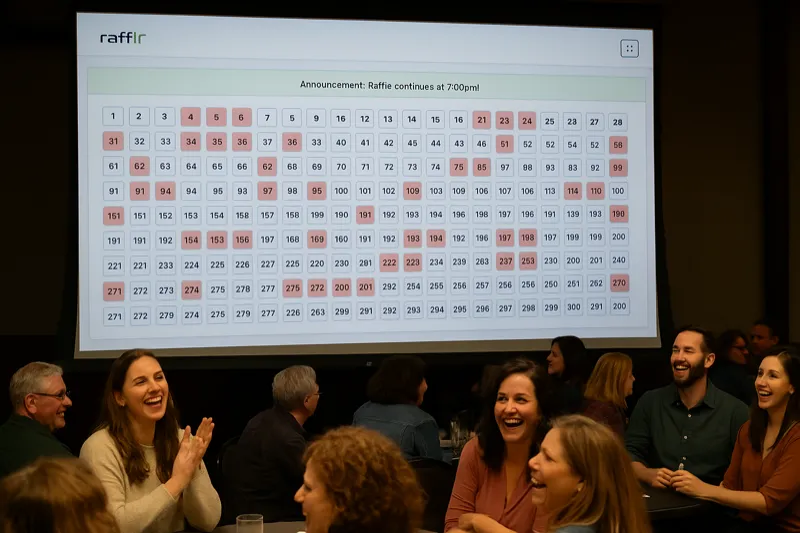
rafflr is purpose-built for this format. It provides a professional presenter view that displays the grid of ticket numbers, animates each elimination, and builds suspense as the field narrows. Organizations that sell tickets online through platforms like Zeffy or RallyUp often pair those sales with rafflr for the drawing. You simply import your ticket numbers into rafflr, connect to a projector or screen at your event, and run the drawing live. Remote ticket holders can watch via a livestream.
Livestreaming the Drawing
For online ticket buyers who cannot attend in person, livestreaming the drawing is essential. It builds trust (they can see the process is fair), increases engagement, and gives remote supporters a reason to participate in future events. Most organizations use Facebook Live, YouTube Live, or Zoom to stream their drawing. Position a camera facing your projection screen and provide audio commentary as numbers are called.
Step-by-Step: Setting Up Your Online Raffle
Here is a practical checklist for getting your online raffle ticket sales up and running:
- Verify legal compliance: Check your state's raffle laws, obtain necessary permits, and draft official rules
- Choose your ticket platform: Select from the comparison table above based on your budget and needs
- Set ticket pricing: Use the prize-to-ticket ratio formula and create bundle options
- Create your raffle page: Include prize photos, descriptions, official rules, drawing date, and a clear purchase button
- Configure payment processing: Connect your bank account and test the checkout flow
- Set up your drawing software: If running a reverse raffle, set up rafflr with your ticket numbers
- Launch marketing campaign: Send your announcement email and first social posts
- Monitor and adjust: Track sales daily and ramp up marketing if you are behind pace
- Run the drawing: Conduct a fair, transparent drawing and notify winners
- Follow up: Thank all participants, announce winners publicly (with permission), and share results
Common Mistakes to Avoid
After working with hundreds of organizations running online raffles, we see the same mistakes repeatedly. Avoid these pitfalls:
- Skipping legal research: "We've always done it this way" is not a legal defense. Verify compliance every time.
- Choosing the cheapest platform regardless of features: Free is not always best. If a platform's poor user experience costs you 20% of potential sales, those "saved" fees end up being very expensive.
- Not offering bundle pricing: Single-ticket-only sales leave significant revenue on the table.
- Launching without marketing: Building a raffle page and hoping people find it does not work. Dedicate real time and effort to promotion.
- Waiting too long to start sales: Give yourself at least 4-6 weeks of selling time. Shorter windows create pressure on your marketing team and limit reach.
- Forgetting the drawing experience: The drawing is what your ticket buyers are ultimately paying for. A boring, unprofessional drawing undermines all the work you put into sales.
- Not collecting buyer contact information: Online ticket sales give you a built-in list of engaged supporters. Use that data (with permission) for future fundraising outreach.
Tax Considerations for Online Raffle Sales
Online raffle ticket sales create tax obligations for both the organization and the winner. Here is what you need to know:
For the Organization
- Raffle ticket purchases are generally not tax-deductible for the buyer because they are receiving something of value (a chance to win) in exchange
- You must issue a Form W-2G to any winner receiving prizes valued at $600 or more
- Keep detailed records of all ticket sales, expenses, and prize distributions
- Some states require filing a raffle report within a specified period after the drawing
For the Winner
- Raffle prizes are taxable income and must be reported on the winner's tax return
- For non-cash prizes, the fair market value determines the taxable amount
- Some organizations withhold federal taxes (typically 24%) from cash prizes above $5,000
Frequently Asked Questions
Is it legal to sell raffle tickets online?
It depends on your state and the type of organization running the raffle. Most states allow qualified nonprofits to sell raffle tickets, but online sales add complexity because you may be selling across state lines. Some states like Alabama and Hawaii prohibit raffles entirely, while others restrict online ticket sales. Always check your state's gambling commission or attorney general's office for specific regulations before selling raffle tickets online.
What is the best platform to sell raffle tickets online?
The best platform depends on your needs. Zeffy is ideal for nonprofits wanting zero platform fees. RallyUp offers the most features for complex fundraising campaigns. TicketSpice provides a polished buyer experience with low per-ticket fees. For the drawing itself, rafflr specializes in live reverse raffle presentations that create excitement at your event. Many organizations use one platform to sell tickets and rafflr to run the actual drawing.
How much should I charge for online raffle tickets?
Price your raffle tickets based on your prize value, audience size, and fundraising goal. A common guideline is to set ticket prices so that selling 50-70% of available tickets covers your prize costs and expenses. For example, if your grand prize is worth $1,000 and you have 200 tickets, pricing them at $10-$20 each is reasonable. Many organizations offer bundle discounts like 3 tickets for $25 or 6 for $40 to increase average order value.
Can I sell raffle tickets online with PayPal or Venmo?
While some organizations accept PayPal or Venmo for raffle tickets, it is not recommended as your primary method. Both platforms' terms of service restrict gambling-related transactions, which can include raffles. Using a dedicated raffle ticket platform with built-in payment processing (like Stripe integration) is safer and provides better tracking, automated receipts, and compliance features.
How do I run the actual raffle drawing after selling tickets online?
After selling tickets online, you need a fair and transparent way to select winners. For standard raffles, most ticket platforms include a basic random drawing tool. For reverse raffles and drawdowns, specialized software like rafflr provides a professional live presentation where numbers are eliminated one by one, creating suspense and excitement. You can stream the drawing live so remote ticket holders can watch in real time.
When Online Ticket Sales Backfire
Online ticket sales are not a universal solution. In certain situations, pushing ticket sales online can actually hurt your fundraiser rather than help it.
- Your audience prefers cash: Some communities -- particularly older demographics or tight-knit local groups -- are more comfortable paying with cash at a table. Forcing them through an online checkout creates friction that reduces participation. If 80% of your buyers are in-person attendees who show up with cash in hand, meet them where they are.
- High platform fees eat your margins: On low-priced tickets ($5-$10), a $1.50-$2.00 per-transaction processing fee can consume 15-30% of your revenue. If your raffle is small and margins are thin, the convenience of online sales may not justify the cost. Do the math before committing. Our guide on how to price raffle tickets walks through these calculations.
- In-person sales build community: At events like church socials, school carnivals, or neighborhood block parties, the act of buying tickets face-to-face is part of the social experience. Volunteers working the ticket table build relationships, answer questions, and create energy that a checkout page cannot replicate.
The smartest approach for many organizations is hybrid: sell tickets online to reach people who cannot attend in person, but keep cash and card sales available at the event itself. This way you capture both audiences without alienating either one.
Putting It All Together
Selling raffle tickets online is no longer a nice-to-have. It is a necessity for organizations that want to maximize their fundraising potential. The right combination of a ticket selling platform for sales and payment processing, a solid marketing plan to drive traffic, and professional drawing software for the event itself creates a fundraising engine that can generate significantly more revenue than traditional in-person-only approaches.
Start by understanding your legal requirements, choose a platform that fits your budget and audience, price your tickets strategically with bundle options, and invest real effort into marketing. Then, when drawing day arrives, make it memorable. Whether you are running a standard raffle, a reverse raffle, or a drawdown, the experience you create for your supporters determines whether they come back next year.